Tampa Bay holds the title of the lightning capital of the United States, and Pasco County’s open, newer-construction lots across Wesley Chapel, Zephyrhills, and the surrounding corridor sit exposed to it more than older, tree-shaded neighborhoods do. A summer afternoon storm rolls through, the power flickers or drops entirely, and when it comes back your AC either doesn’t restart on its own or restarts and immediately trips off again. Before assuming the worst, there’s a short list of things worth checking.
This is usually about lightning, not hurricanes
It’s worth separating this from hurricane-specific prep, since most power outages in this corridor have nothing to do with tropical systems. Tampa Bay’s summer storm pattern produces intense, localized lightning activity nearly every afternoon during the wet season, and a nearby strike or a utility-side outage from storm activity is a far more common cause of a sudden AC shutdown than an actual hurricane. The checks below apply just as much to a random July thunderstorm outage as to anything storm-season related.
Start with the disconnect box
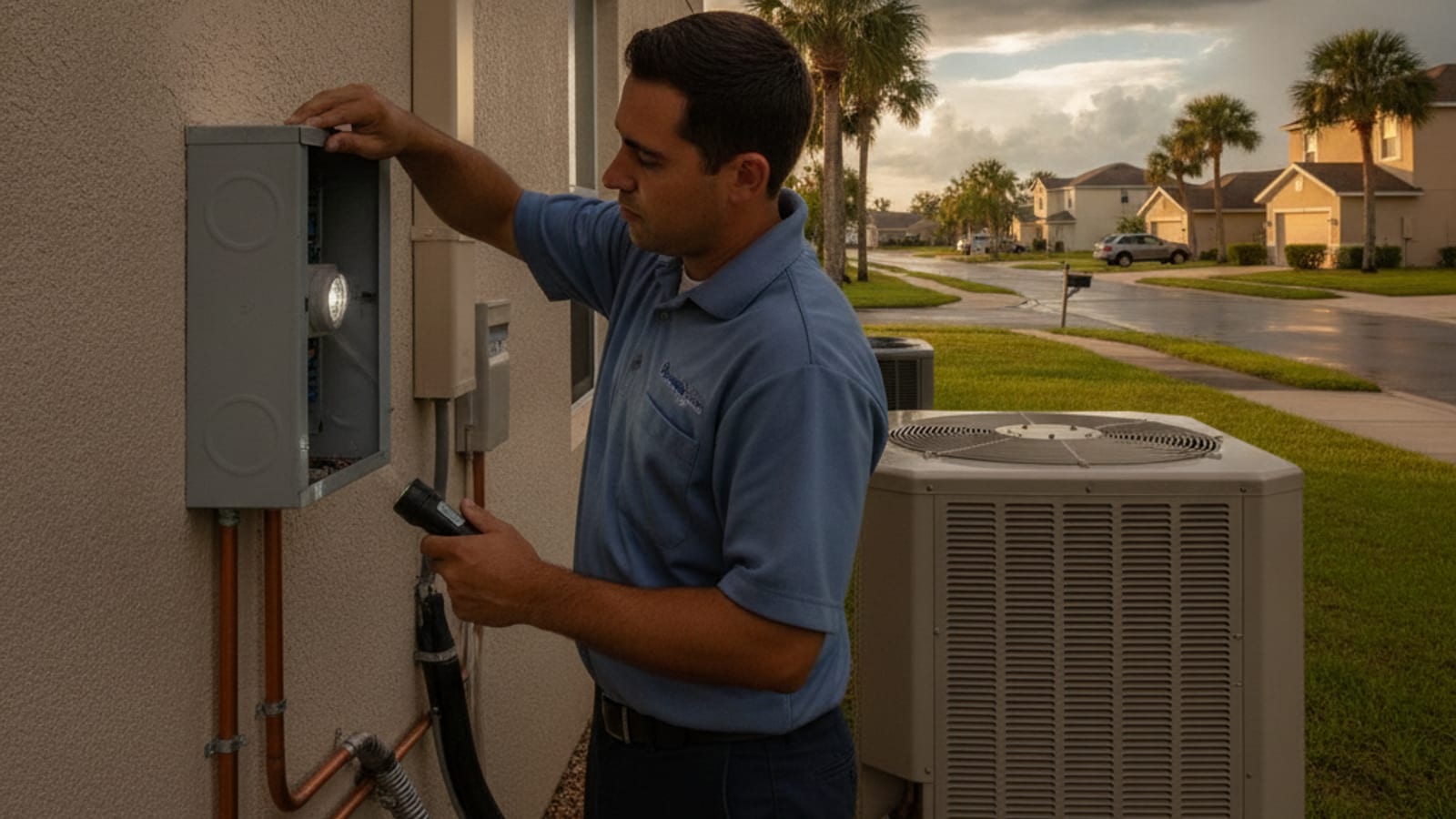
Every outdoor AC condenser has a disconnect box mounted on the wall near the unit, usually a small gray metal box with a pull-out fuse block or a breaker switch inside. A power surge or outage sometimes trips this disconnect even when nothing else in the house lost power, which can leave the outdoor unit dead while the indoor air handler and thermostat still show normal operation. Check whether the disconnect switch is in the on position, or whether the pull-out block is fully seated if your system uses that style. This is genuinely a five-minute check, and it resolves a meaningful share of no-restart calls after a storm without needing a service visit at all.
Check your breaker panel
If the disconnect box looks normal, the next step is your home’s main electrical panel. AC systems typically run on a dedicated double-pole breaker, and a power surge during an outage can trip it even if the rest of the house’s circuits are fine. Look for a breaker that’s in the middle position rather than fully on, switch it fully off and then back on, and see whether the system responds. If it trips again immediately after resetting, that’s a sign of an actual electrical fault rather than a simple trip, and it’s time to stop troubleshooting and call for a real diagnostic.
Give the system a few minutes before assuming failure
Modern AC systems, particularly heat pumps, have a built-in delay, sometimes called a compressor short-cycle protection or time-delay relay, that prevents the compressor from restarting immediately after a power interruption. This protects the compressor from damage that can occur from restarting against residual system pressure. If your system doesn’t respond the instant power comes back, wait five to ten minutes before assuming something’s actually wrong. A lot of “my AC won’t turn on after the outage” calls resolve on their own once this delay period passes.
When it’s a five-minute fix versus a real board failure
A tripped disconnect or breaker that resets and holds is the good outcome. It means the system’s control components came through the outage fine, and the interruption was purely electrical. A board failure looks different: the system may power on but not respond to the thermostat at all, run erratically, or trip the breaker repeatedly no matter how many times you reset it. Control board damage from a power surge is a real and common outcome of a nearby lightning strike, and it’s not something a homeowner can diagnose or fix without a technician actually testing the board and its connections.
If you’ve checked the disconnect, reset the breaker once, waited out the compressor delay, and the system still isn’t responding normally, that’s the point to call for emergency HVAC service rather than continuing to reset breakers, since repeatedly cycling a breaker on a system with an actual electrical fault can make the underlying damage worse.
Surge protection as prevention
A dedicated surge protection device installed at the outdoor condenser’s control board is a relatively low-cost addition, typically $150 to $350 installed, that can prevent exactly this kind of lightning-driven board failure in the first place. Given how frequently this corridor’s newer, more open neighborhoods take direct or near-direct lightning activity during summer storm season, it’s one of the more cost-effective additions available for a system that’s otherwise healthy, and it’s worth asking about the next time you’re already having AC repair or maintenance work done.
What to do while you wait, if a service call is needed
If the basic checks don’t resolve it and you’re waiting on a service visit, especially during a stretch of hot weather, a few things help manage the situation without doing anything that risks making an electrical issue worse. Keep blinds and curtains closed on sun-facing windows to reduce heat gain in the meantime. Avoid running major heat-generating appliances, ovens, dryers, during the hottest part of the day if the house is already struggling to stay cool. And resist the urge to keep resetting the breaker repeatedly if it’s tripping again each time, since that repeated cycling can compound damage on a system with an actual electrical fault rather than just a one-time surge event.
If anyone in the household has a medical condition sensitive to heat, or there are young children or elderly family members at home, it’s worth treating a prolonged outage more seriously and having a plan, whether that’s a cooling center, a relative’s house, or simply prioritizing getting a technician out same day rather than waiting for a standard appointment window.
Why this happens more in newer Wesley Chapel neighborhoods
Older, more established neighborhoods with mature tree canopy sometimes see less direct lightning exposure at ground level, since taller trees can take a strike that would otherwise hit a home’s roofline or exterior equipment. Wesley Chapel’s newer sections, Mirada, Epperson, Connerton, and similar communities built on cleared land with young or minimal tree cover, don’t have that same natural buffer yet. Outdoor AC condensers on these more exposed lots see more direct strike risk than equivalent equipment in an older, more shaded part of the metro, which is part of why surge protection tends to come up more often in conversations with homeowners in these specific communities.
Don’t rule out storm damage entirely
While most outage-related AC issues in this market trace back to a tripped disconnect, breaker, or a surge-damaged board, it’s worth a visual check of the outdoor unit itself after any severe storm. Debris impact, water intrusion into the disconnect box, or visible damage to the unit’s cabinet are signs the issue goes beyond electrical and needs a full inspection before the system runs again.
Why does my AC not turn back on right after the power comes back?
Most modern systems have a built-in delay of several minutes to protect the compressor from restarting under pressure. This is normal and not a sign of a problem on its own. Give it 5 to 10 minutes before troubleshooting further.
Is a tripped AC breaker after a storm always serious?
Not necessarily. A single trip that resets and holds is usually just the electrical system’s normal response to a surge or brief outage. A breaker that trips repeatedly after resetting points to an actual fault and needs a technician.
How do I protect my AC’s control board from lightning strikes?
A dedicated surge protection device installed at the outdoor unit is the most direct prevention. Given Tampa Bay’s lightning frequency, it’s a worthwhile addition for most homes in this corridor, particularly newer, more exposed lots.
Should I turn off my AC entirely during a lightning storm?
Some homeowners choose to shut the system off at the thermostat or disconnect during an active, close-range storm as an extra precaution, though a properly grounded system and installed surge protection reduce the need for this. If you do shut it off, give it a few minutes after power stabilizes and the storm passes before turning it back on, rather than restarting it in the middle of continued lightning activity.
Does homeowners insurance cover AC damage from a lightning strike?
Many homeowners policies do cover lightning-related electrical damage, though coverage specifics vary by policy and insurer. If you suspect a strike damaged your system, document the damage and contact your insurer alongside getting a professional diagnosis, since you’ll likely need both a repair estimate and cause documentation for a claim.
Always verify a contractor’s CAC license directly at myfloridalicense.com before letting anyone touch storm-related equipment, especially if the issue is tied to an active insurance conversation.
If your Pasco County AC won’t restart after a storm outage and the basic checks haven’t fixed it, call (813) 000-0000 and we’ll connect you with an experienced, insured local pro who can diagnose whether it’s a simple reset or real board damage.