Most homes in Seven Oaks, Meadow Pointe, Bexley, Connerton, and Mirada came with an AC system the builder picked, not one a homeowner chose. That system was sized off a spec sheet for the floor plan, installed on a schedule that matched the framing crew, and handed over with a one-year builder walkthrough that’s long since ended. If your house went up anywhere in this corridor between the early 2010s and today, there’s a real chance the original unit is closer to the end of its service life than the “it still runs fine” story in your head.
Where to find the real age
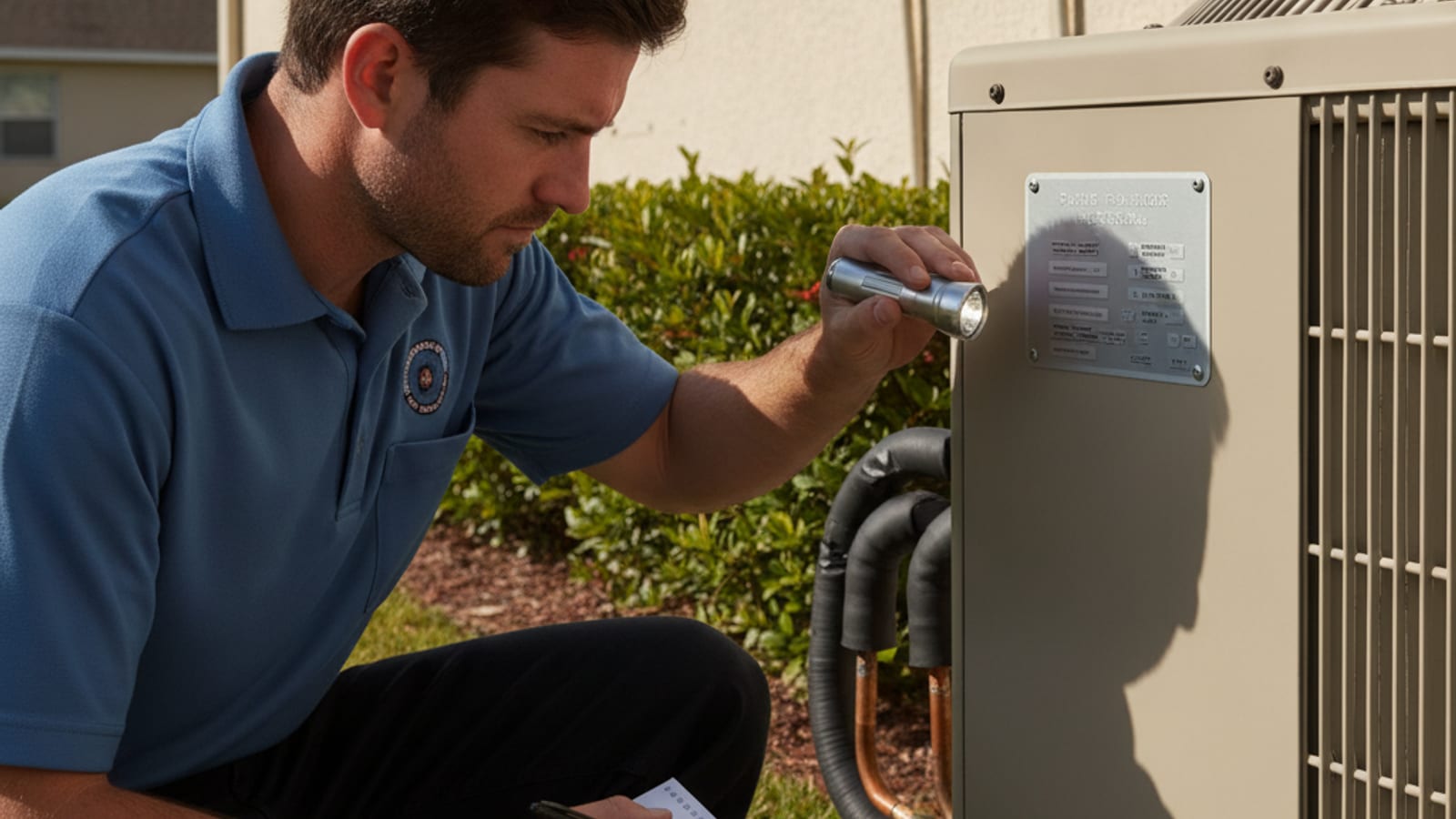
Every outdoor condenser and indoor air handler carries a manufacturer data plate, usually a metal or foil sticker on the side or back of the cabinet. Look for a serial number, not a model number. Most major manufacturers encode the manufacture date into the first four digits of the serial, two for the year and two for the week. A serial starting with 1608 means the unit rolled off the line in the eighth week of 2016, not 2018 when you might have closed on the house or 2020 when you moved in. Builders sometimes install equipment months before a home actually sells, so don’t assume the closing date and the manufacture date match.
If the data plate is faded or missing, the model number can still narrow things down. A technician can cross-reference it against the manufacturer’s production records during a routine AC repair or tune-up visit, so it’s worth asking next time someone is already out at the house.
Why 10 to 15 years is the real window here
National averages for AC lifespan get thrown around a lot, usually somewhere around 15 to 20 years. That number assumes decent installation practices and a climate that isn’t running the system nearly nonstop for seven or eight months a year. Wesley Chapel doesn’t get that assumption. Florida humidity keeps compressors cycling longer per run, and builder-grade equipment installed to hit a construction budget isn’t always the same tier as a system someone chooses and pays for directly.
What we see in the field across Seven Oaks and Meadow Pointe in particular is compressor and capacitor failures starting to show up in the 10 to 15 year range, not the 18 to 20 year range some homeowners are expecting. That doesn’t mean every builder-grade system fails on a countdown timer. It means the failure curve starts earlier here than the national number suggests, and a homeowner who assumes they have five more years left based on a generic lifespan chart can get caught off guard by a July breakdown.
What “still running” doesn’t tell you
A system that turns on and blows cold air isn’t necessarily a healthy system. Refrigerant charge drifts low over years of small leaks nobody notices. Capacitors weaken gradually, drawing more amperage to do the same job, which shows up as a higher electric bill long before it shows up as a failure to start. Ductwork connected to an aging system can develop leaks at the boots and joints that were fine at installation but have loosened with a decade of thermal expansion and contraction in a hot attic.
None of that stops the system from running. It just means it’s running less efficiently, cooling less consistently, and pulling less moisture out of the air than it did when it was new. If your Wesley Chapel home feels colder but still humid, or your summer electric bill has crept up without an obvious cause, an aging builder-grade system is a common explanation worth ruling out before assuming something else is wrong.
The replacement decision, not a scare tactic
None of this means every 12-year-old system in Seven Oaks needs to come out this summer. Some builder-grade equipment was installed well and has been maintained since. The point is that “it’s still running” isn’t the same question as “is this still the right system for my house,” and the second question deserves a real answer once a unit crosses the 10-year mark. A proper Manual J load calculation, done as part of any AC installation quote, tells you whether a replacement should match the old unit’s tonnage or correct for a house that was never quite right-sized in the first place. That’s a common finding in this market: a builder-installed system sized to hit a number on paper, not the actual cooling load of the finished home with its furniture, occupants, and window placement.
If you’re weighing a repair against a replacement, a straightforward rule holds up well in this corridor: a major component failure (compressor, coil) on a system already past 10 years usually tips the math toward replacement, especially once you factor in that a repair only extends the life of everything else that’s aging alongside it. A capacitor or contactor failure on the same system doesn’t carry the same logic. That’s a normal wear part, and swapping it doesn’t mean the whole unit is on its way out.
A note on the federal tax credit
Homeowners sometimes ask about the federal 25C energy efficiency tax credit when they’re pricing a replacement. That credit expired for equipment installed after December 31, 2025, so it isn’t part of the current cost equation for a 2026 replacement in Wesley Chapel. Utility rebate programs through Duke Energy and TECO do come and go, and amounts change, so the honest answer is to confirm whatever is currently available directly with your installer at quote time rather than planning around a number you saw somewhere online.
Other signs worth watching alongside the age
The data plate is a starting point, not the whole story. A few other signs tend to show up alongside an aging builder-grade system, and any one of them combined with a unit past the 10-year mark is worth a real look. Short cycling, where the system runs for a few minutes, shuts off, then kicks back on again shortly after, is one of the more common ones, and it often gets dismissed as normal behavior when it’s actually a sign of a failing capacitor or a refrigerant charge that’s drifted off spec. A condenser that’s noticeably louder than it used to be, especially a new rattling or grinding sound during startup, points toward a motor or fan blade issue that tends to show up more in equipment that’s already logged a decade of Florida summers.
Rising electric bills without a clear explanation, no new appliances, no change in household size, no unusually hot stretch of weather, are another indicator worth tracking. A system losing efficiency draws more power to deliver the same cooling output, and that shows up on the bill well before it shows up as an actual failure. Homeowners who keep a rough mental note of their summer electric costs year over year are often the first to notice this pattern, sometimes before a technician would catch it on a routine visit.
Comparing a Wesley Chapel replacement to a repair-only path
Some homeowners want a clear number to compare against before deciding. As a rough guide, if a single repair is quoted above 30 to 50 percent of what a full replacement would cost, and the system is already past the 10-year mark, replacement usually makes more financial sense over a 5-year horizon, since you’re not just paying for one fix, you’re likely paying for the next one too on equipment that’s already showing its age. That threshold isn’t a hard rule, and a technician who’s actually inspected your specific unit can give you a more precise read than a general guideline, but it’s a useful gut check when a repair quote comes in and you’re trying to decide whether it’s worth it.
What to do if your system is in that window
Start with the data plate. If your Wesley Chapel or New Tampa home’s system is reading 10 years or older, get a real inspection rather than waiting for a breakdown to force the decision. That inspection should look at refrigerant charge, electrical component wear, coil condition, and airflow, not just whether the thermostat call gets answered. Ask directly whether a load calculation was ever done on the house, since a lot of original builder installs skip that step in favor of matching a standard spec.
Always verify a contractor’s CAC license directly at myfloridalicense.com before committing to a major replacement. It’s a two-minute check that confirms who’s actually going to be doing the work on one of the more expensive systems in your home.
How do I read the manufacture date on my AC’s data plate?
Look for the serial number, not the model number, on the metal or foil sticker attached to the outdoor condenser or indoor air handler. Most major manufacturers encode a two-digit year and two-digit week into the first four digits of the serial. A technician can confirm the exact format for your specific brand if the plate is hard to read.
Is a 10-year-old AC system in Wesley Chapel already worth replacing?
Not automatically. Age alone isn’t a reason to replace a system that’s still running efficiently and hasn’t shown other warning signs. It’s a reason to get a real inspection rather than assuming you have another decade left based on a national average that doesn’t reflect Florida’s climate demands.
Does regular maintenance actually extend a builder-grade system’s life?
Yes, meaningfully. A system that’s had annual professional maintenance since installation tends to reach the higher end of its realistic lifespan, while one that’s never had more than a filter change is more likely to show problems earlier. Maintenance history is one of the first things worth mentioning to a technician evaluating your system’s condition.
If you’re not sure whether your Wesley Chapel or Pasco County AC is closer to the beginning or the end of its useful life, call (813) 000-0000 and we’ll connect you with an experienced, insured local pro who can read the data plate, run a real inspection, and give you a straight answer instead of a guess.