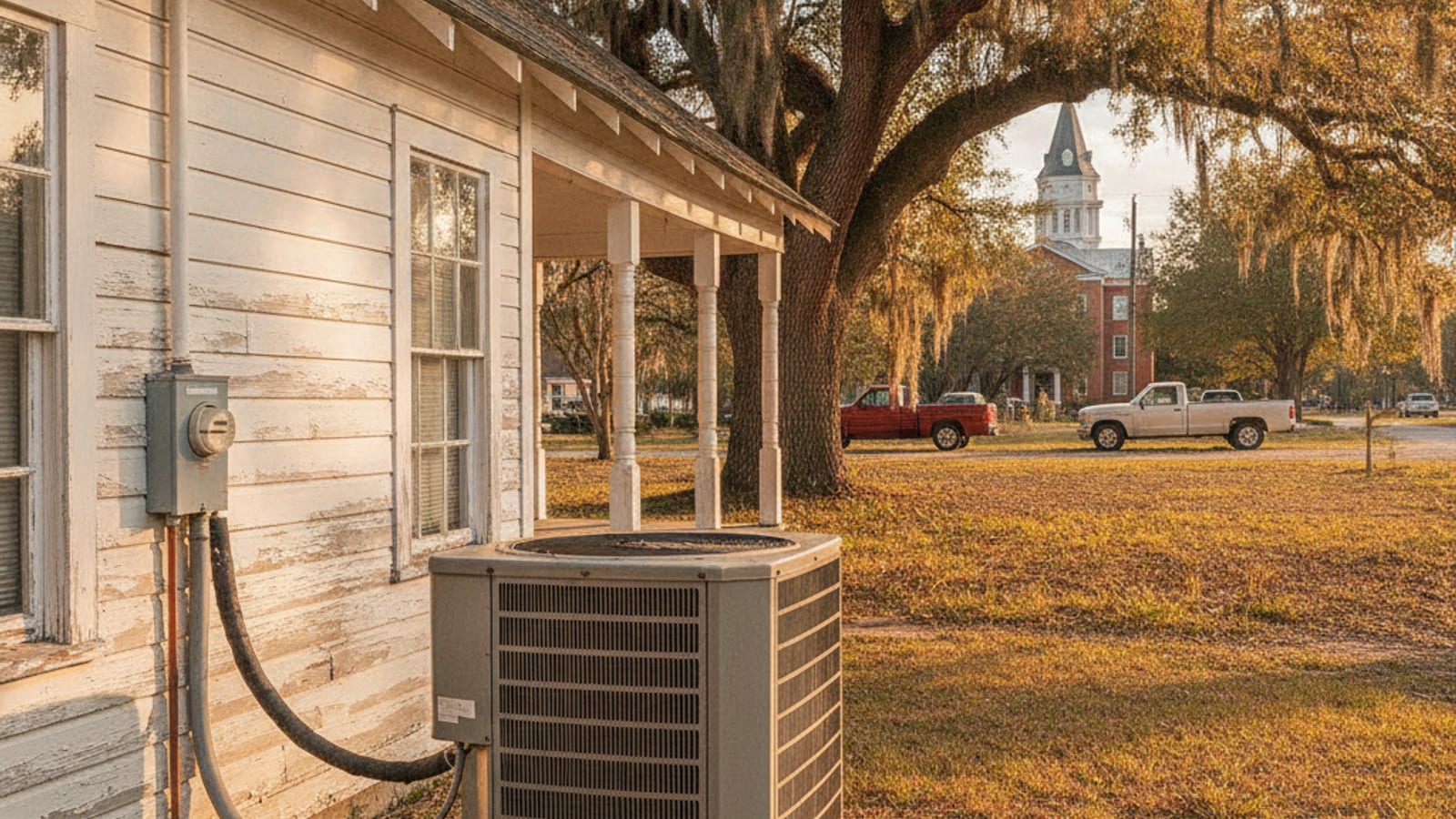
Drive twenty minutes east from Wesley Chapel toward Zephyrhills, Dade City, or San Antonio, and the housing stock tells a completely different story. Instead of two-story production homes finished in the last decade, you’re looking at ranch homes from the 1980s and 1990s, historic cores dating back much further around Dade City’s courthouse square, and rural parcels that have carried the same HVAC equipment for twenty-plus years. The AC conversation out here isn’t about builder-grade systems aging out early. It’s about genuinely old equipment that’s earned every bit of its wear.
A different starting point than the new-build corridor
Wesley Chapel’s newer sections deal with systems hitting 10 to 15 years and already showing failure patterns tied to builder-grade equipment quality. East Pasco is a different clock entirely. Downtown Zephyrhills, Zephyr Shores, the historic downtown and courthouse square area of Dade City, and San Antonio’s town center around Saint Leo University sit on housing built well before the recent construction boom, and a lot of the AC equipment in these homes is original or close to it, sometimes 20 years old or more.
That changes the whole conversation with a technician. In Wesley Chapel, a repair-versus-replace decision often hinges on whether a specific component failure is worth fixing on a system that still has years left in its expected lifespan. In East Pasco, it’s more common to be having that conversation on a system that’s already well past any reasonable service life, where the real question isn’t whether this particular repair is worth it, but whether the next one will be too.
Repair-versus-replace is a real conversation more often here
A capacitor or contactor failure on a 5-year-old Wesley Chapel system is a straightforward, inexpensive fix. The same failure on a 22-year-old system in a Dade City ranch home is worth pausing on, because it’s rarely an isolated issue on equipment that old. An AC repair visit on genuinely aged equipment often surfaces a second or third issue once a technician is actually inside the unit, refrigerant that’s been topped off before without addressing the underlying leak, a compressor drawing higher amperage than it should, coil corrosion that’s been building for years.
The honest math on older equipment: repairs in the $150 to $650 range make sense on a system with real years left. On a 20-plus year old unit already showing multiple wear indicators, that same repair cost sometimes just delays a replacement that’s coming regardless, without meaningfully extending the system’s useful life. A technician who’s straight with you about that trade-off, rather than defaulting to the easiest fix, is worth more than one who just replaces the failed part and moves on.
What replacement looks like on older housing stock
Replacing a system in an older Zephyrhills or Dade City home isn’t always a straightforward swap. Ductwork installed decades ago may not match modern system airflow requirements, especially if the original equipment ran a different tonnage or a different blower configuration than what’s standard today. Electrical service in some of these older homes wasn’t built for a modern system’s amperage draw, so a replacement project sometimes needs an electrical scope alongside the AC installation itself, not just a like-for-like equipment swap.
Rural properties around Crystal Springs, the Wire Road corridor, and the agricultural outskirts near Dade City and San Antonio bring their own considerations too. Larger lots, sometimes with well water and septic systems, and longer drive times for service calls that Wesley Chapel’s tighter subdivisions don’t require. A straightforward replacement quote in this part of the metro should account for the home’s actual electrical and ductwork condition, not just the square footage.
What to check before assuming replacement is the only option
An old system isn’t automatically a dead system. Some homeowners in Dade City’s historic district and San Antonio’s town center have maintained original equipment carefully for two decades and gotten real value out of it. Before assuming a 20-year-old unit needs to come out, it’s worth a genuine inspection: refrigerant type (older R-22 systems face a different cost equation since that refrigerant is being phased out and increasingly expensive to source), coil and compressor condition, and how the system has actually been maintained over its life.
If the system runs R-22 refrigerant, that’s usually the deciding factor on its own. R-22 production for U.S. use has been phased out, and refrigerant for a leak repair on an older R-22 system, if it can be sourced at all, often costs enough to tip the math firmly toward replacement rather than repair.
What maintenance history tells a technician
On an older system, a documented maintenance history is worth more than it is on newer equipment, because it tells a technician how the unit has actually been treated over its life rather than leaving them to guess based on a single inspection. A 20-year-old system with annual professional tune-ups on record has usually had small problems caught and corrected along the way, refrigerant leaks addressed early, coils kept clean, electrical connections checked. A system of the same age with no maintenance record at all is more of an unknown, and a technician evaluating it has to assume the worst-case scenario until proven otherwise.
If you’re a longtime homeowner in Dade City or Zephyrhills without a clear maintenance record, that’s not a reason to panic, but it is a reason to be more thorough about the inspection before deciding between repair and replacement. Starting fresh with documented annual HVAC maintenance going forward, even on a system you’re expecting to replace within a few years, gives you and any future technician a clearer picture of how the equipment is actually holding up.
This matters just as much for homeowners planning to sell in the coming years. A buyer’s inspector in this market routinely flags an aging AC system with no service history as a negotiating point, sometimes resulting in a price reduction or a repair credit request that costs more than a few years of documented maintenance would have. A clean, dated service record is a small thing that can carry real weight during a future sale, on top of the direct benefit of catching problems early.
A note on rural and well-water properties
Homes around Crystal Springs, the outskirts near Trilby and Lacoochee, and the more rural stretches near San Antonio sometimes run larger AC systems than a comparable-sized Wesley Chapel home, since bigger lots with less shade and older, less efficient window and insulation packages drive up cooling load. If you’re pricing a replacement out here, mention the property’s rural characteristics directly rather than assuming a quote based on square footage alone captures the full picture.
Should I repair or replace a 20-year-old AC system in Dade City or Zephyrhills?
It depends on the specific failure and the system’s refrigerant type. An R-22 system with a refrigerant leak usually points toward replacement given sourcing costs. A newer-refrigerant system with an isolated component failure and no other wear indicators might still be worth a repair. A real inspection, not a phone estimate, is the only way to know for sure.
Why does East Pasco see older AC systems than Wesley Chapel?
The housing stock itself is older. Zephyrhills, Dade City, and San Antonio’s cores were built well before the recent Wesley Chapel and New Tampa construction boom, so the AC equipment installed in those homes has simply had more years to age, independent of anything about equipment quality.
Do rural East Pasco properties need larger AC systems?
Often yes. Bigger lots with less shade and, in some cases, older or less efficient building materials drive up cooling load compared to a similarly sized home in a newer, more shaded subdivision.
Is it worth upgrading ductwork at the same time as replacing an old AC system?
In a lot of older Dade City and Zephyrhills homes, yes. If the existing ductwork was sized for a different equipment configuration decades ago, installing new equipment onto old, mismatched ductwork can undercut the performance gains you’re paying for. It’s worth having your ductwork evaluated as part of any replacement quote rather than treating it as a separate future project.
How long does a full AC replacement take in an older East Pasco home?
A straightforward like-for-like replacement is often a one-day job. Projects that also require electrical upgrades or significant ductwork modification, more common in genuinely old housing stock than in newer construction, can take two to three days depending on the scope. Your contractor should walk through the expected timeline before work begins.
If your AC system in Zephyrhills, Dade City, San Antonio, or anywhere in East Pasco is showing its age, call (813) 000-0000 and we’ll connect you with an experienced, insured local pro who can give you a straight repair-or-replace read instead of just patching whatever failed this time.