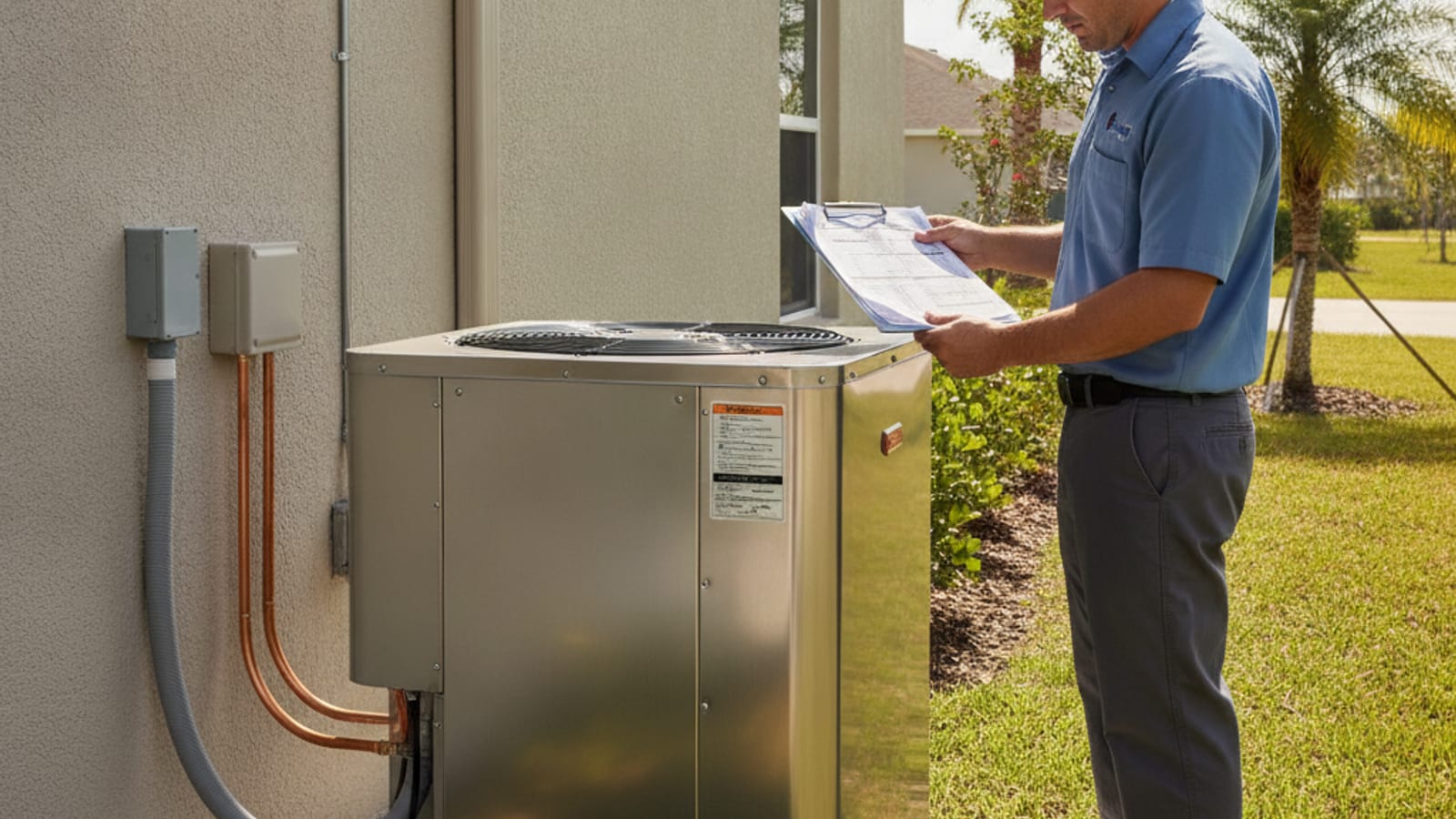
When it’s time to replace a heat pump in a two-story Wesley Chapel home, the fastest path is also the one most likely to leave you with the same comfort problems you had before: matching the new unit’s tonnage to whatever the old one was. That number, in a lot of Epperson, Meadow Pointe, and Seven Oaks-style homes, was never actually right in the first place. It was a builder’s default sized to hit a construction spec, not a number calculated for your specific house.
Why matching old tonnage repeats old mistakes
If your original system left the upstairs warm, ran constantly without pulling humidity down, or short-cycled through the afternoon heat, installing a new unit at the exact same capacity just buys you a newer version of the same problem. Tonnage that was wrong for the house doesn’t become right because the equipment is new. A replacement project is the one moment where correcting that sizing mistake is realistic without tearing into finished walls, and skipping that opportunity to just match the old number is a common and avoidable miss.
What a real load calculation accounts for
A Manual J load calculation, the industry-standard method for sizing residential HVAC equipment, looks at far more than square footage. It factors in window area and orientation (a two-story home with a lot of west-facing upstairs glass carries a different load than an identical floor plan facing north), insulation levels, ceiling height, number of occupants, and how the floors are split between conditioned zones. For a two-story production home in this corridor, the upstairs and downstairs often carry meaningfully different loads even within the same total square footage, which matters when deciding whether a single system can serve both floors adequately or whether zoning should be part of the replacement conversation.
Skipping this step and matching old tonnage is faster and sometimes cheaper up front, but it’s a false economy on a system you’re expecting to run for the next decade or more. The cost of a proper load calculation is small relative to the cost of the equipment itself, and it’s worth confirming with your installer that one is actually being done rather than assumed.
The SEER2 standard for a builder-grade replacement
Federal minimum efficiency standards shifted to SEER2 testing, which better reflects real-world ductwork resistance than the older SEER metric. If you’re replacing an original builder-grade heat pump that predates this standard, the new system you install will be rated under SEER2 regardless, so it’s worth understanding that a SEER2 number on a spec sheet isn’t directly comparable to the old SEER rating your builder-grade unit carried. A technician quoting your replacement should be able to explain what efficiency tier makes sense for your specific home and usage pattern, rather than just quoting the minimum-compliant option by default.
Higher-efficiency equipment costs more upfront but can meaningfully lower a summer electric bill in a climate where the system runs nearly year-round. Whether that trade-off pencils out depends on how long you plan to stay in the home and your specific usage pattern, which is a conversation worth having directly rather than assuming higher efficiency always wins on the math.
Why oversizing causes real problems in this climate
An oversized heat pump cools a room fast and then shuts off before it’s had time to pull meaningful moisture out of the air. That’s the mechanism behind a genuinely common complaint in Wesley Chapel and New Tampa: a thermostat reading 72 in a house that still feels clammy. Short-cycling also puts more wear on the compressor over time, since starting and stopping repeatedly is harder on the equipment than running a longer, steady cycle. An oversized system isn’t a safety margin. It’s a design flaw that shows up as both higher humidity and a shorter equipment lifespan.
Single system versus zoning for a two-story replacement
A replacement project is the natural point to reconsider whether a single system serving both floors is still the right approach, or whether the load calculation results make a case for zoning instead. If the calculation shows a genuinely large difference between the upstairs and downstairs loads, common in floor plans with a lot of west-facing upstairs glass, a single system sized to average the two floors can end up compromising on both, running too cool downstairs while still struggling to keep pace upstairs.
Zoning splits that single system’s output between floors using motorized dampers and a second thermostat, letting each floor call for cooling independently rather than sharing one setpoint. It costs more upfront than a standard single-zone replacement, but for a household that’s dealt with years of upstairs discomfort, it’s worth pricing out as part of the replacement conversation rather than defaulting to the same single-zone configuration the builder originally installed.
What to ask before signing a replacement quote
A few direct questions separate a quote built around your actual house from one built around convenience. Ask whether a Manual J load calculation was performed, and ask to see the results, not just be told one was done. Ask what SEER2 rating the proposed equipment carries and how that compares to your old system’s actual performance, not just its age. Ask directly whether zoning was considered given your home’s two-story layout, even if the answer is that a single zone is still the right call for your specific floor plan.
A contractor who answers these questions specifically, with numbers and reasoning tied to your house, is giving you a different quality of quote than one who answers in generalities. It’s a reasonable thing to ask multiple contractors during the quoting process, since the answers themselves tell you something about how carefully each one is actually looking at your home.
Comparing quotes that use different tonnage numbers
It’s common to get two or three quotes back on a replacement project and find they specify different tonnage for the same house. That difference is worth investigating rather than just picking the lowest bid or the biggest number. Ask each contractor to walk through how they arrived at their recommended size, and specifically whether it came from an actual load calculation or from matching the existing system. A quote that can’t answer that question clearly is a signal to look elsewhere, since sizing is the single decision most likely to determine whether you’re happy with the replacement two summers from now.
What right-sizing actually costs
A right-sized SEER2 heat pump replacement for a typical two-story Wesley Chapel or New Tampa home generally runs $6,000 to $14,000 installed as part of a full AC installation, depending on tonnage, ductwork condition, and whether the project includes duct sealing or repair alongside the main equipment swap. Homes needing a zoning retrofit or a whole-home dehumidifier addition to fully solve a persistent humidity complaint will land toward the higher end of that range or beyond it. Get an itemized quote that separates equipment cost from labor, ductwork work, and any add-ons, so you can see clearly what’s driving the total.
Getting the sizing conversation right from the start
Ask directly whether your replacement quote includes a Manual J load calculation or whether it’s based on matching your existing system’s tonnage. That single question separates a quote built around your actual house from one built around convenience. For homes in Wesley Chapel or New Tampa where upstairs comfort or persistent humidity has been an issue, that calculation is the difference between fixing the root problem and installing a newer version of it.
How do I know if my current heat pump is oversized?
Short cycling is the clearest sign, the system running for a few minutes, shutting off, then starting again shortly after, without ever running a longer, steady cooling cycle. A house that reaches a cool temperature quickly but still feels humid is another strong indicator, since an oversized system satisfies the thermostat before it’s had time to properly dehumidify the air.
Does a bigger heat pump always cool a two-story home better?
No, and this is one of the more persistent misconceptions homeowners run into. A properly sized system that runs longer, steadier cycles removes more humidity and maintains more even comfort than an oversized system that short-cycles, even though the oversized unit technically has more raw cooling capacity on paper.
How often should a load calculation be redone if my home hasn’t changed?
If your home’s structure, insulation, and window configuration haven’t changed since the last calculation, the numbers generally hold. It’s worth redoing the calculation any time you’re replacing the system, adding square footage, or making significant changes to insulation or windows, since any of those shifts the actual load.
If your current heat pump is leaving your two-story home unevenly cooled or humid despite running constantly, call (813) 000-0000 and we’ll connect you with an experienced, insured local pro who will run a real load calculation before quoting a replacement, not just match what’s already there.