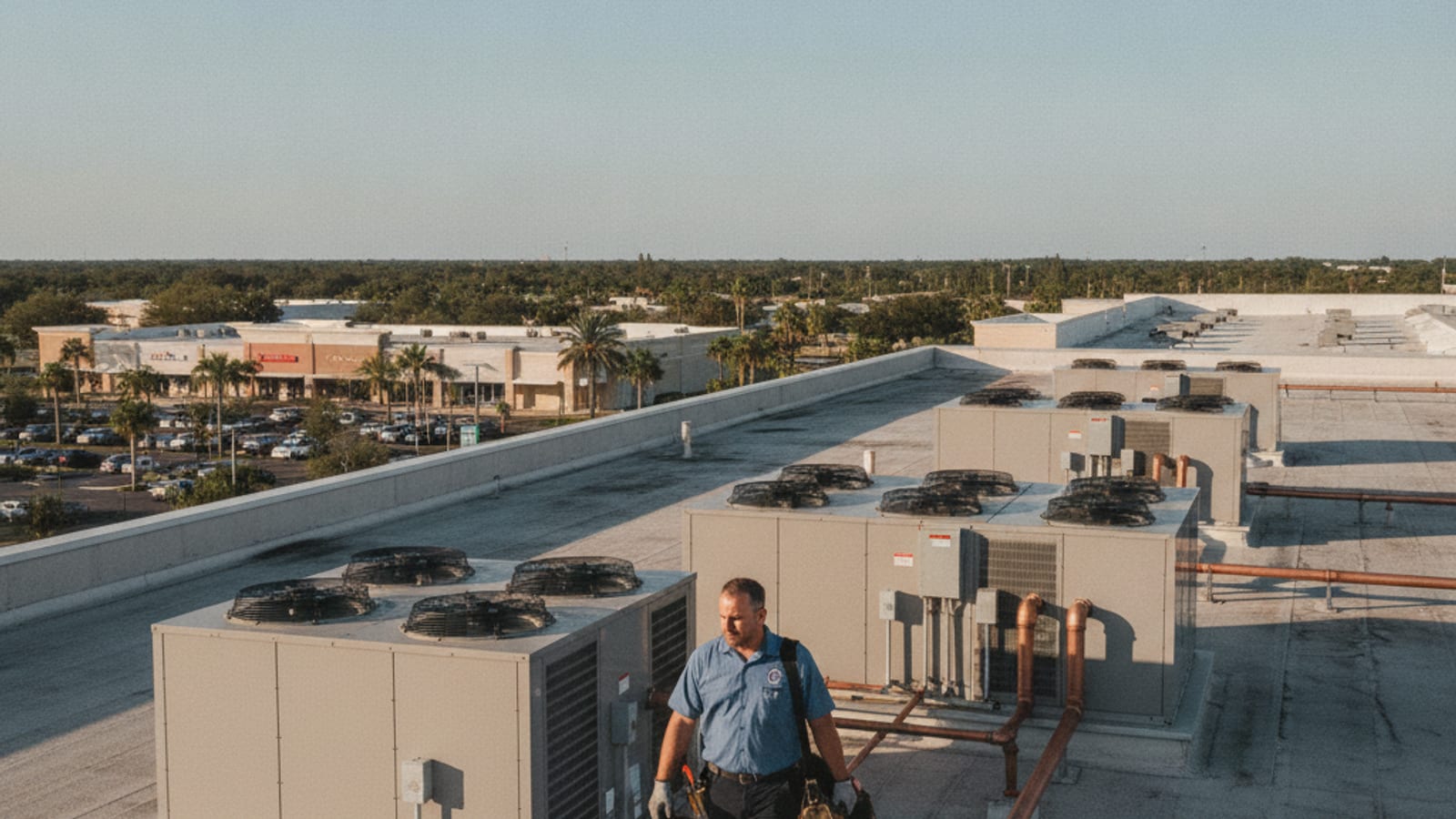
The residential boom in Wesley Chapel didn’t happen in isolation. Retail, dining, and office space have followed the rooftops, and the Shops at Wiregrass corridor along Bruce B. Downs Boulevard has grown into one of the busier commercial stretches in Pasco County. Restaurants, retail storefronts, medical offices, and professional space have all expanded here over the same years that Seven Oaks, Meadow Pointe, and the surrounding neighborhoods filled in, and that commercial growth brings a completely different HVAC conversation than a residential replacement.
Rooftop package units versus residential split systems
Most retail and office space in this corridor runs on rooftop package units rather than the split systems you’d find in a house, a single unit mounted on the roof that handles both the compressor and air handling functions in one cabinet, ducted down into the space below. That configuration is standard for commercial buildings because it keeps mechanical equipment off the sales floor or office space entirely and simplifies service access, a technician works entirely from the roof rather than needing interior access during business hours for most maintenance and repair work.
Sizing a rooftop unit for retail or office space involves different math than a home. Occupancy load (how many people are typically in the space), equipment heat load from kitchen equipment in a restaurant or server racks in an office, and how the space’s layout affects airflow distribution all factor in differently than a residential load calculation. A commercial HVAC quote for a Wiregrass-area retail space should reflect the specific use of that space, not a generic square-footage estimate.
Why after-hours scheduling matters here
A restaurant or retail tenant along the Wiregrass corridor can’t take a daytime HVAC outage the way a homeowner can reschedule around a service visit. Lost cooling during business hours means lost sales, uncomfortable customers, and in a restaurant’s case, real food safety and kitchen equipment concerns if refrigeration or kitchen exhaust systems are affected too. That’s why commercial HVAC service in this corridor runs heavily toward after-hours and early-morning scheduling for anything beyond an emergency call, maintenance, filter changes, and non-urgent repairs scheduled before opening or after closing rather than disrupting a business day.
For tenants planning routine HVAC maintenance, it’s worth setting up a standing after-hours arrangement with a service provider rather than negotiating scheduling every time a visit comes up. A predictable maintenance schedule also catches small problems, a failing capacitor, a refrigerant level trending down, before they become an emergency that does force a daytime shutdown.
What emergency commercial service looks like
When a rooftop unit does fail during business hours, particularly in a restaurant kitchen where equipment heat load makes the space uninhabitable fast without cooling, response time matters in a way it doesn’t for a routine residential call. A true emergency HVAC response for commercial tenants along this corridor should mean same-day or faster dispatch, not a next-available-slot conversation, given what’s at stake for a business losing operating hours.
It’s worth confirming with any commercial HVAC provider what their actual emergency response commitment looks like before you need it, not after a Friday dinner rush loses cooling and you’re calling around trying to find someone who can get on the roof same day.
Multi-tenant and shared-system considerations
Some of the newer retail and office buildings along this corridor use shared or zoned commercial systems serving multiple tenant spaces, which adds a layer of coordination that a single-tenant building doesn’t require. If your commercial space shares mechanical infrastructure with neighboring units, whether responsibility falls on the tenant, the property manager, or the building owner should be spelled out clearly in your lease, and it’s worth having that conversation before a system issue forces a scramble to figure out who’s responsible for the repair.
What growth along this corridor means for equipment demand
The pace of retail and office construction around Wiregrass and the surrounding SR-56 and Bruce B. Downs corridor has outpaced a lot of other commercial stretches in Pasco County over the past several years, and that growth shows up in the kind of HVAC work we’re seeing now. New tenant build-outs need rooftop units sized and installed as part of the initial construction, existing buildings that have changed tenants are seeing new occupants request equipment upgrades to match a different use case than the space was originally designed for, and older commercial buildings in the immediate area are starting to see their original rooftop equipment reach replacement age at the same time demand for commercial service across the corridor is climbing.
That combination means scheduling lead time for non-emergency commercial work has gotten tighter than it was a few years ago. Property managers and tenants planning a build-out or a proactive equipment replacement are better served getting on a contractor’s schedule well ahead of a hard deadline, rather than waiting until a lease commencement date is bearing down and discovering availability is limited.
Choosing a provider familiar with this specific corridor
Commercial HVAC work along the Wiregrass corridor benefits from a contractor who already understands the specific mix of tenant types here, restaurant kitchen exhaust and refrigeration interplay, retail space with high customer-traffic cooling demands, and office space with more standard occupancy-driven load. A provider who’s worked in this corridor before can move faster on both sizing and scheduling than one quoting a commercial job in this specific retail environment for the first time.
Pricing a service call or maintenance contract
Commercial HVAC pricing in this corridor typically starts around $150 for a single rooftop unit service call, with maintenance contracts priced by square footage and the number of units on the roof rather than a flat rate. A restaurant or larger retail space running multiple rooftop units will see a different total than a small professional office running a single unit, so get a scope-specific quote rather than assuming a flat number applies across different business types.
For businesses weighing a maintenance contract against pay-as-you-go service calls, the math generally favors a contract for any tenant with real exposure to a business-hours outage, restaurants especially, since the cost of prevented downtime tends to outweigh the contract’s annual cost.
Lease terms worth clarifying up front
Commercial leases along this corridor handle HVAC responsibility differently depending on the property and landlord. Some leases place full responsibility for rooftop equipment maintenance and replacement on the tenant, others keep it with the landlord or property management company, and some split it, tenant responsible for routine maintenance, landlord responsible for major repair or replacement once equipment reaches a certain age. Before signing or renewing a lease along the Wiregrass corridor, get clear on which scenario applies to your space, since discovering the answer during an actual equipment failure is a bad time to learn you’re on the hook for a rooftop unit replacement you didn’t budget for.
How is commercial HVAC different from residential AC service in Wesley Chapel?
Commercial systems typically use rooftop package units rather than residential split systems, and service scheduling accounts for business hours in a way residential service doesn’t need to. Sizing also factors in occupancy and equipment heat load specific to the business, not just square footage.
Can commercial HVAC maintenance be scheduled after hours?
Yes, and for most retail and restaurant tenants along the Wiregrass corridor, that’s the standard approach so routine maintenance doesn’t interrupt business operations.
What should a restaurant do if kitchen HVAC fails during service?
Contact your commercial HVAC provider immediately and confirm their actual emergency response timeline. Given the equipment heat load in a commercial kitchen, a cooling outage during service hours needs same-day attention, not a standard scheduling window.
How often should a rooftop commercial unit be serviced?
Most commercial rooftop units benefit from at least twice-yearly professional maintenance, once before the heavy summer cooling season and once in the fall, though restaurants and higher-occupancy retail spaces sometimes need more frequent service given the extra load on the equipment. Your specific maintenance interval should reflect your business type and the unit’s actual run hours.
Is it cheaper to repair or replace an aging rooftop unit along this corridor?
It depends on the unit’s age, the specific failure, and how it compares to current energy costs from an older, less efficient system. A commercial HVAC provider should walk through both options with real numbers, repair cost against expected remaining life versus replacement cost against efficiency gains, rather than defaulting to either option automatically.
If your retail, restaurant, or office space along the Wiregrass or Wesley Chapel corridor needs commercial HVAC service, call (813) 000-0000 and we’ll connect you with an experienced, insured local pro who understands what after-hours and emergency response actually needs to look like for a business.