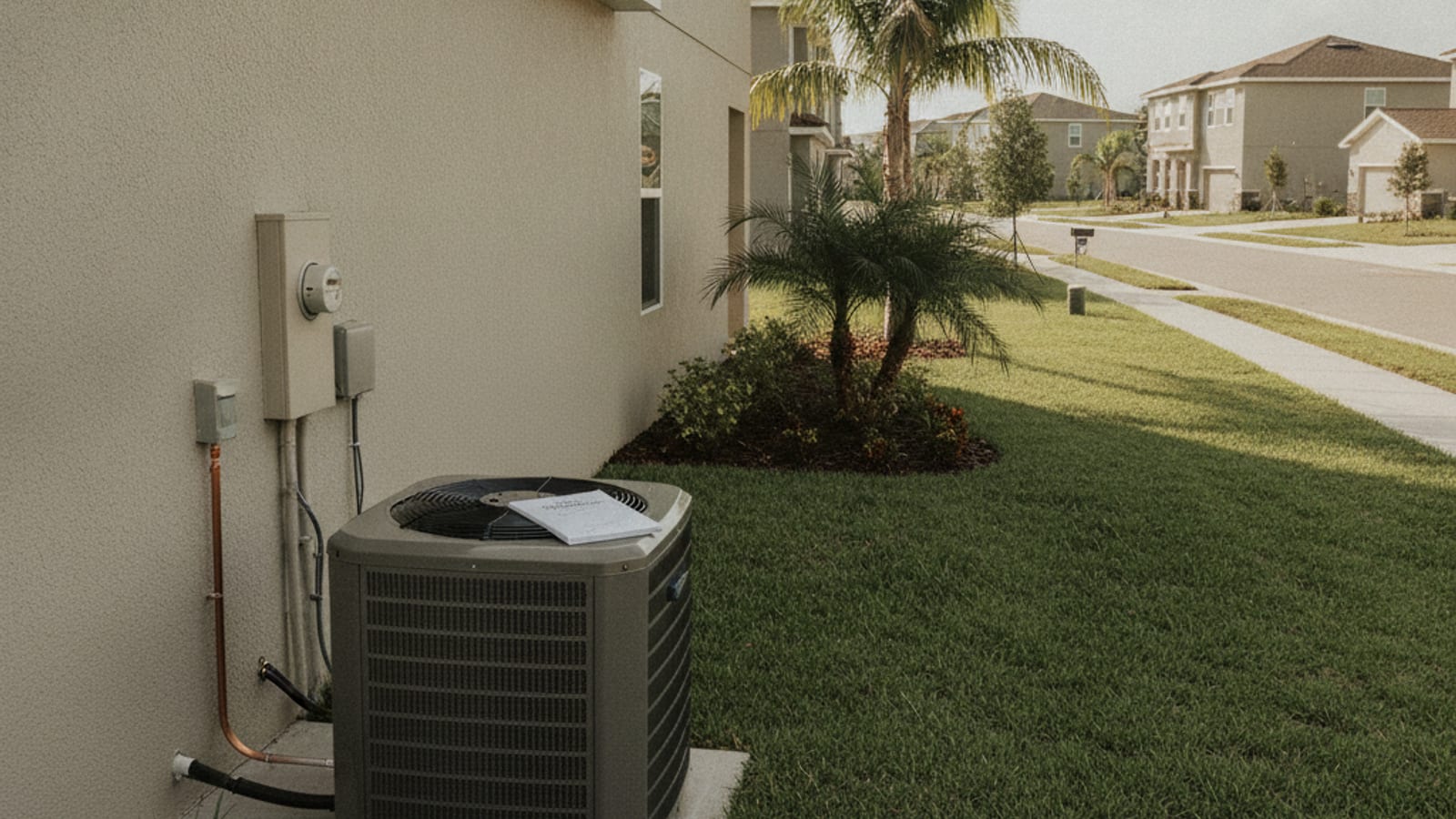
Buying new construction in a community like Epperson, Mirada, or Union Park comes with a stack of warranty paperwork that most homeowners skim once at closing and never look at again. HVAC coverage is one of the more confusing pieces of that stack, because it isn’t actually one warranty. It’s two or three separate coverages with different timelines, different responsible parties, and different rules for what voids them.
The builder’s first-year walkthrough period
Most Florida production builders include HVAC operation as part of a one-year workmanship warranty covering the home broadly. During that first year, a system that isn’t cooling properly, cycling correctly, or performing to the specs promised at sale is generally the builder’s responsibility to address, often through a warranty request process rather than a direct call to an HVAC company. This period is meant to catch installation problems, not normal wear, so a builder walkthrough claim is the right move for issues that show up early: uneven cooling that was there from move-in, unusual noise from day one, or a system that never seemed to keep up with the home’s actual load.
Homeowners in newer sections of Wesley Chapel like Mirada or Connerton should keep documentation of any HVAC concerns raised during that first year, including dates and what was reported, since builder warranty claims move faster with a paper trail than with a verbal complaint that’s hard to trace back later.
Where builder responsibility ends and manufacturer coverage begins
Once the first-year walkthrough period closes, the builder’s direct involvement in HVAC issues typically ends. From that point forward, coverage shifts to whatever manufacturer parts warranty came with the specific equipment installed, plus any labor warranty a homeowner separately purchased or that came bundled with the installation. This is where things get genuinely confusing, because manufacturer parts warranties on compressors, coils, and other major components often run 5 to 10 years, but that coverage is parts only in a lot of cases. Labor to actually diagnose and replace a failed part under a parts-only warranty isn’t automatically free, and homeowners are sometimes surprised by a labor bill on a system they thought was still “under warranty.”
Registration matters here too. Most manufacturers require homeowner registration of the equipment within a set window after installation, often 60 to 90 days, to activate the full extended parts warranty term rather than defaulting to a shorter base coverage period. This step gets missed constantly on new construction, since it’s easy to assume the builder or original installer handled it. It’s worth confirming directly whether your system’s warranty is actually registered, since an unregistered system can default to a much shorter coverage window than the homeowner assumed they had.
What voids or complicates warranty coverage
A few things commonly trip up warranty claims on new-construction systems in this market. Skipping documented annual maintenance is the most common one. Most manufacturer warranties require proof of regular professional maintenance to keep the parts warranty valid, and a claim can be denied or delayed if there’s no service history to show the system was maintained per the warranty’s terms. This is a real argument for scheduling HVAC maintenance annually even on a newer system that seems to be running fine, since skipping it can cost more than the maintenance visit itself if a later warranty claim gets denied for lack of documentation.
Unauthorized repairs or modifications by someone other than a licensed technician can also void portions of a warranty, as can using non-approved refrigerant or parts during any service work. And a system that was never right-sized to begin with, running an oversized or undersized unit against the home’s actual load, isn’t a defect a warranty claim typically covers, since it’s a design issue rather than a parts failure.
Getting a load calculation confirmed
Since builder-grade systems are sometimes sized to a spec plan rather than the finished home’s actual conditions, it’s worth asking early, ideally during that first-year walkthrough window, whether a real load calculation was performed on your specific house. If comfort complaints (a room that never cools, humidity that lingers) show up in year one, raising the sizing question directly with the builder while you’re still inside the workmanship warranty period is more useful than waiting until year three when that avenue has closed. Getting ahead of a sizing problem is far cheaper than paying for an AC installation do-over later.
If you’re buying a resale home instead of new construction
Not everyone reading this is the original owner. If you’re purchasing a resale home in a newer Wesley Chapel community, one that’s only a few years old, it’s worth finding out during the inspection period whether the original HVAC warranty is transferable to a second owner. Manufacturer parts warranties often do transfer, sometimes with a small administrative fee and a window of time after closing to complete the transfer paperwork, but builder workmanship warranties typically do not extend past the original owner regardless of how young the home is. Ask the seller directly for the original installation paperwork and any manufacturer registration confirmation, since that documentation is what makes a warranty transfer possible at all. A resale home without that paperwork on hand isn’t necessarily uncovered, but confirming coverage takes an extra step of contacting the manufacturer directly with the equipment’s serial number.
Keeping your own documentation
Whether you’re the original owner or bought resale, keeping your own file of HVAC-related paperwork, the original installation invoice, manufacturer registration confirmation, and every maintenance visit’s service record, puts you in a stronger position if a warranty claim ever comes up. Homeowners who can hand a technician a clear maintenance history make warranty claims move faster, since a lot of the documentation a manufacturer wants to see is exactly what a homeowner without organized records struggles to produce months or years after the fact. It’s a small habit, saving a digital copy of every HVAC-related invoice and service report, that pays off directly if a major component ever fails while parts coverage is technically still active.
What a realistic timeline looks like
Put together, a typical new-construction Wesley Chapel HVAC warranty picture looks something like this: builder workmanship coverage for the first year, manufacturer parts coverage running anywhere from 5 to 10 years depending on registration and equipment tier, and labor coverage that’s often shorter than the parts coverage unless a separate extended labor warranty was purchased. None of those numbers are guaranteed figures, since terms vary by builder and manufacturer, which is exactly why confirming your specific coverage at quote time or during a service call matters more than relying on a general timeline like this one.
Does the federal tax credit apply to a new-construction HVAC system?
The federal 25C energy efficiency tax credit expired for equipment installed after December 31, 2025, so it isn’t part of the current picture for a 2026 new-construction system. Any current utility rebate programs through Duke Energy or TECO should be confirmed directly at the time of any service or upgrade, since amounts and availability change.
How do I find out if my system’s manufacturer warranty is registered?
Check the paperwork from your original installer or builder, or contact the equipment manufacturer directly with your unit’s serial number. If registration was never completed, ask whether a late registration is still possible, since policies vary by manufacturer.
What should I do if a builder warranty claim and a manufacturer warranty overlap?
Start with whichever warranty is still active and covers the issue you’re experiencing. A technician can help identify which coverage applies once they’ve diagnosed the actual problem, since the right path depends on what specifically failed.
Can I use any HVAC company for warranty-covered repairs, or does it have to be the original installer?
This depends on the specific manufacturer and warranty terms. Some manufacturer warranties require repairs to be performed by an authorized dealer to remain valid, while others allow any licensed technician as long as approved parts are used. Check your warranty documentation or ask the manufacturer directly before scheduling a repair you expect to be covered.
Is a home warranty the same thing as a manufacturer HVAC warranty?
No, and this mix-up causes real confusion. A third-party home warranty is a separate paid service contract, unrelated to the manufacturer’s parts warranty or the builder’s workmanship coverage. It has its own terms, exclusions, and claims process, and it’s worth understanding which coverage, if any, actually applies before assuming a repair is covered by one or the other.
If you’re not sure what’s still covered on your Wesley Chapel new-construction HVAC system, or you want a straight read on your equipment’s registration and maintenance status, call (813) 000-0000 and we’ll connect you with an experienced, insured local pro who can walk through it with you.