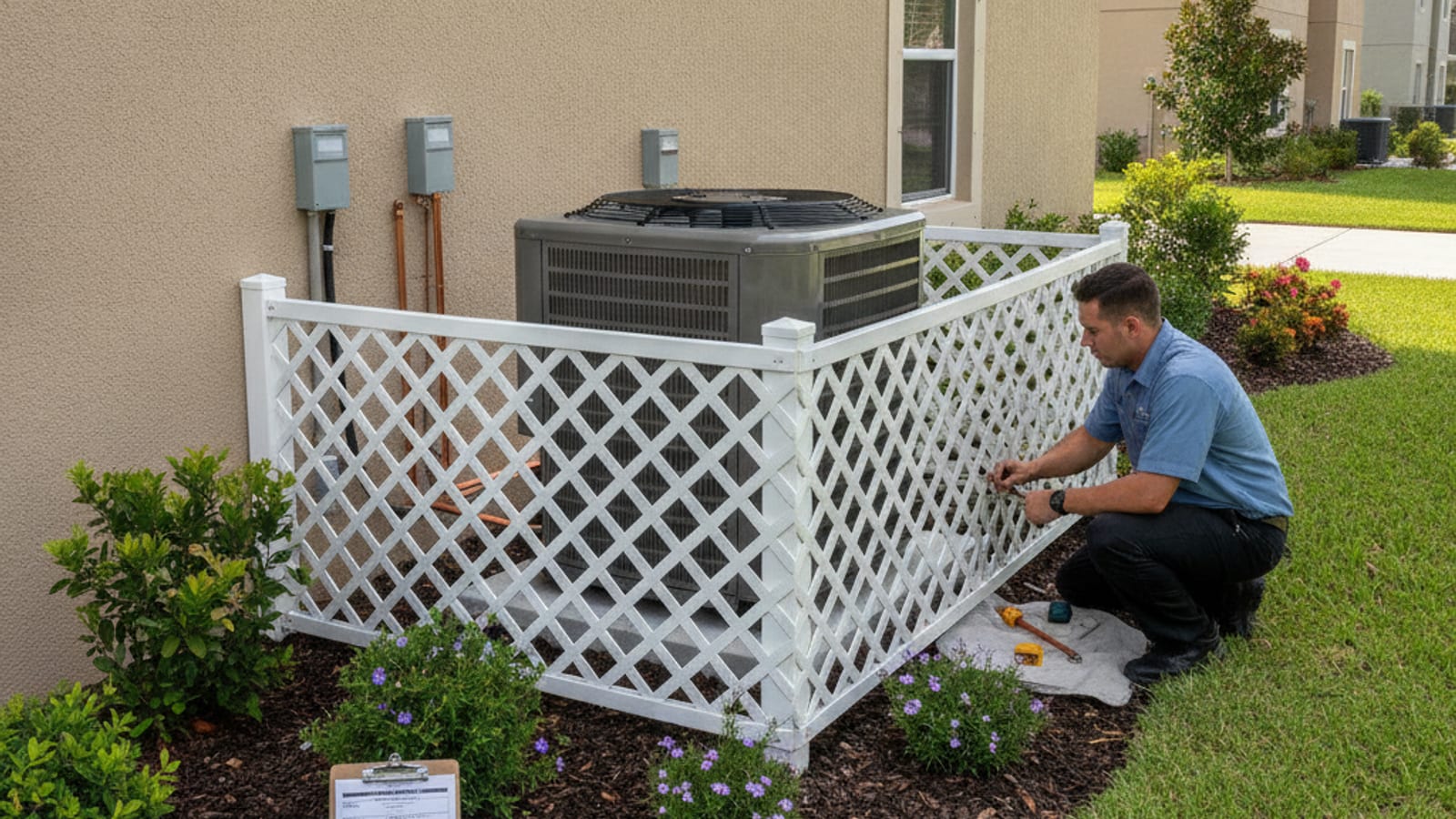
Nearly every master-planned community across Wesley Chapel and Land O’ Lakes runs an architectural review process, and an outdoor AC condenser falls squarely inside it. That surprises some homeowners the first time a routine replacement turns into a paperwork step, but it’s standard practice in Seven Oaks, Meadow Pointe, Bexley, Del Webb Bexley, Connerton, and most of the HOA-governed neighborhoods that make up this corridor. Knowing what’s typically required before you request approval saves real time.
Why a mechanical swap needs sign-off at all
HOA architectural guidelines exist to keep exterior appearance consistent across a community, and outdoor mechanical equipment gets treated the same as a fence, a shed, or an exterior paint change in most of these documents. That applies even to a like-for-like replacement of an existing unit in the same spot, not just a new installation somewhere different. The logic is that the guidelines govern what’s visible from the street or common areas, not just what’s new to the property.
In practice, this means a homeowner replacing a failed condenser in Meadow Pointe on an emergency basis still technically owes the HOA a notification, even though the urgency of a no-cool call in July doesn’t leave much time for a monthly architectural review meeting. Most communities have some process for expedited or after-the-fact notification for exactly this situation, so it’s worth asking your HOA management company directly rather than assuming emergency work is automatically exempt.
Screening requirements
Screening is the most common requirement across these communities. Outdoor condensers typically need to be shielded from direct street view, either with approved landscaping, a low fence or lattice panel, or a permanent screen wall in some higher-end sections. The specifics vary by community, some approve a specific plant list for landscaping screens, others require a particular fence style or material to match the home’s existing fencing. Check your community’s design guidelines document before assuming a generic solution will pass.
Screening also has a practical side beyond HOA compliance. A condenser needs clearance on all sides for proper airflow, generally at least 24 inches, so a screening solution that boxes the unit in too tightly can hurt its performance and shorten its service life. A well-designed screen accounts for both the HOA requirement and the unit’s actual clearance needs.
Setback and placement rules
Most communities specify where a condenser can and can’t sit relative to property lines, easements, and sometimes the neighboring home’s windows or patio. Side-yard placement is standard in nearly every HOA guideline document in this corridor, since it keeps the unit out of front-yard sightlines while staying accessible for service. Placement also affects performance: a unit tucked against a west-facing wall in direct afternoon sun runs less efficiently than one placed in partial shade, so it’s worth considering both the HOA rule and the unit’s own efficiency when deciding on location during an AC installation.
Paint and finish specifications
Some of the newer, more design-controlled communities, particularly higher-end sections of Bexley and Del Webb Bexley, specify that visible mechanical equipment match approved exterior color palettes or be finished to blend with the home rather than stand out in factory white or beige. This is less common than screening and setback rules but worth checking, since it can affect equipment selection or require a factory or field-applied finish that adds cost and lead time to a project.
What if your community’s guidelines are outdated or unclear
Some of the older HOA design guideline documents in this corridor were written before ductless mini-splits, larger modern condensers, or specific efficiency-driven equipment sizes were common, which means a homeowner can occasionally hit a guideline that simply doesn’t address the equipment they’re installing. When that happens, don’t assume silence means no approval is needed. Reach out to the HOA management company directly and ask how they want to handle a piece of equipment the current guidelines don’t explicitly cover. Getting that answer in writing, even a simple email confirmation, protects you if a screening or placement question comes up later.
It’s also worth asking whether your community’s guidelines have been updated recently, since some HOAs revise their architectural standards every few years and a homeowner working from an old printed copy or an outdated PDF can end up submitting a request based on requirements that no longer apply.
Working with your HVAC contractor on the submission
A contractor who’s done work in your specific community before is a real advantage during this process. They’ve likely already navigated that HOA’s submission format, know what documentation the review committee typically asks for, and can often provide the equipment specs and site plan information in the format the HOA expects without back-and-forth delay. If you’re getting quotes for a replacement, new AC installation, or a mini-split for a lanai or bonus room, it’s a reasonable question to ask each contractor directly: have you worked in this specific neighborhood before, and do you know what their architectural review typically requires.
What to have ready before requesting approval
Most architectural review applications ask for the same basic information: the equipment’s exact location on the lot (often shown on a site plan or plot survey), dimensions of the unit, and a description of the screening or fencing plan if one is required. Having your contractor’s proposed placement and equipment specs in hand before you submit speeds up the process considerably, since a request that comes back with follow-up questions can add weeks to a timeline that a complete submission from the start wouldn’t have hit.
If your community has a design guidelines document available through the HOA management portal, read the mechanical equipment section directly rather than relying on secondhand advice from a neighbor. Guidelines get updated, and what applied to a neighbor’s install three years ago isn’t guaranteed to match the current version.
Timing the approval process against your project
HOA architectural review committees don’t all meet on the same schedule. Some review submissions weekly, others monthly, and a few require in-person board presentation for anything beyond a straightforward replacement. If you’re planning a full AC installation or replacement project rather than an emergency swap, submitting your architectural request as early as possible in the planning process avoids having equipment ready to install while a paperwork approval is still pending.
For homeowners in Wesley Chapel or Land O’ Lakes planning a replacement, it’s worth having this conversation with your HOA management company at the same time you’re getting quotes, not after you’ve already picked equipment and a contractor.
Does my HOA need to approve an emergency AC replacement?
Most communities require notification even for emergency, like-for-like replacements, though the process is often expedited compared to a standard architectural review. Check with your specific HOA management company, since the process varies by community.
What happens if I install without HOA approval?
Enforcement varies by community, but unapproved installations can result in a violation notice and, in some cases, a requirement to relocate or re-screen equipment after the fact, which costs more than getting approval up front. It’s worth doing right the first time.
Do all Wesley Chapel and Land O’ Lakes communities require screening for outdoor AC units?
Most of the master-planned HOA communities do, though the specific requirements vary. Older or non-HOA-governed neighborhoods in this corridor may not have the same formal screening requirement, so check your community’s specific governing documents.
Can I be fined for installing an AC unit without HOA approval?
It’s possible, depending on your community’s enforcement policy. Some HOAs issue a warning and a deadline to come into compliance before any fine, while others move more quickly to formal violation notices. Either way, it costs less time and money to get approval before installation than to fix a compliance issue afterward.
How far in advance should I submit an HOA request before a planned AC replacement?
As early as possible once you know a replacement is coming, ideally as soon as you start getting quotes. Some review committees meet monthly, so submitting only after equipment is already scheduled for installation risks a timing conflict between your contractor’s availability and your HOA’s next review date.
If you’re planning a replacement or new installation in an HOA-governed Wesley Chapel or Land O’ Lakes community, call (813) 000-0000 and we’ll connect you with an experienced, insured local pro who can help plan placement and screening that satisfies both your HOA and the unit’s actual performance needs.